
 Français
 简体中文
简体中文 Español
 Italiano
 Português
When Fermentis first introduced ViniLiquid™, the concept was straightforward: a yeast autolysate fermentation activator, formulated and stabilized as a liquid. What followed over the next 15 years was something more significant. Winemakers who adopted it didn’t just report easier handling. They reported faster, more complete fermentations, healthier yeast populations, and wines with more expressive aromatic. The liquid format, it turned out, wasn’t only a packaging decision. It was also a technical one.
The key insight from 15 years of field data: physical form matters as much as nutrient composition when it comes to fermentative power. ViniLiquid™ was the first yeast autolysate fermentation activator produced and stabilized in liquid form, and that distinction drives real, measurable differences in how yeast behaves from inoculation through to fermentation completion.
This article draws on that accumulated experience to explain why, and what it means for your winemaking.
Rethinking What “Fermentation Nutrition” Really Means
Most conversations about fermentation nutrition start and end with nitrogen. Yeast assimilable nitrogen (YAN) is the standard metric, and for good reason: nitrogen deficiency is one of the leading causes of sluggish and stuck fermentations. But reducing fermentation nutrition to a single number misses a big part of the picture.
We prefer to speak of fermentative power rather than simply YAN supply. Fermentative power is the combined capacity of a nutrient to:
- Increase fermentation speed and reduce overall fermentation time
- Support the completion of fermentation, even under stressful conditions
- Maintain yeast population viability, particularly in the critical late stages
- Reduce stress factors produced by the yeast that are detrimental to lactic acid bacteria
What Drives Fermentative Power?
YAN contributes, of course. But fermentative power also depends on the presence of insoluble support elements (yeast hulls), survival factors such as sterols and long chain unsaturated fatty acids, growth factors including vitamins and minerals, and critically, the physical form in which all of these are delivered to the must.
Yeast derivatives, as a category, are the most widely used enological products in wineries after active dry yeasts, precisely because they address several of these dimensions simultaneously. Research on yeast derivative composition confirms that compounds released during autolysis, including peptides, amino acids, sterols, and mannoproteins, play roles well beyond simple nitrogen supply: they improve cell membrane integrity, support detoxification of fermentation inhibitors, and modulate wine aroma and structure.
The question is not whether to use a yeast derivative. The question is which form delivers the most complete fermentative power.
Why the Liquid Format Changes Everything
ViniLiquid™ is a highly degraded yeast autolysate that combines the benefits of soluble intracellular yeast content with insoluble yeast hull fractions, all in a single, stable liquid matrix. This is not simply a matter of dissolving a dry product in water. The production and stabilization process is fundamentally different, and it preserves the bioavailability of key compounds in a way that dry processing cannot fully replicate.
Superior Fermentative Power vs. Dry Autolysates
In controlled trials comparing ViniLiquid™ to dry yeast autolysates with equivalent nutrient compositions, ViniLiquid™ consistently outperformed on fermentation speed and yeast population outcomes. The most striking result: when combined with oxygen micro-addition, ViniLiquid™ reduced fermentation time by up to 42% compared to an unsupplemented control fermentation.
The combined effect of ViniLiquid™ and oxygen supply is particularly important in nutrient-poor musts. Compared with dry-format alternatives, the liquid form delivers a stronger fermentative response, helping secure fermentation completion even under difficult conditions.
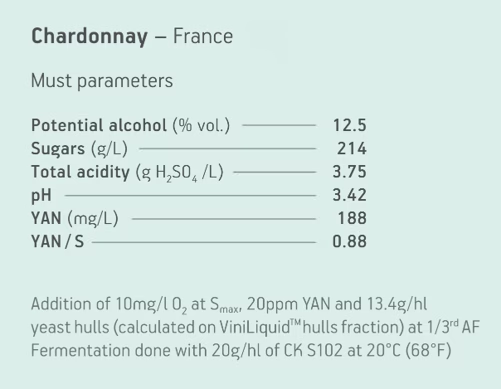
Trial conditions: Chardonnay must, France. Must parameters shown above.
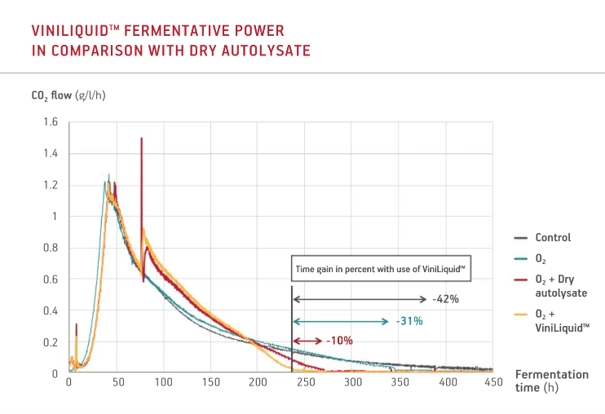
Trial conditions: Chardonnay must, France. Must parameters shown above.
Why does liquid form make a difference?
The physical state of a nutrient influences how quickly and uniformly it interacts with the yeast cell membrane. A liquid autolysate disperses immediately and homogeneously throughout the must, ensuring that survival factors, sterols, and amino acids are available to yeast cells without the lag time associated with rehydration and dissolution of dry formats.
Better Yeast Viability, Especially Late in Fermentation
One of the most consistent findings across 15 years of use in the field is the effect of ViniLiquid™ on yeast population dynamics in the second half of fermentation. This is the period when yeast are under maximum stress: ethanol accumulation is high, residual nutrients are depleted, and fermentation is most at risk of stalling.
ViniLiquid™ generates a measurable surge in yeast population and viability at this stage, a response that dry yeast derivatives, even at equivalent YAN levels, do not reliably produce. The practical consequence is fewer stuck fermentations, more predictable fermentation timelines, and reduced need for emergency interventions.
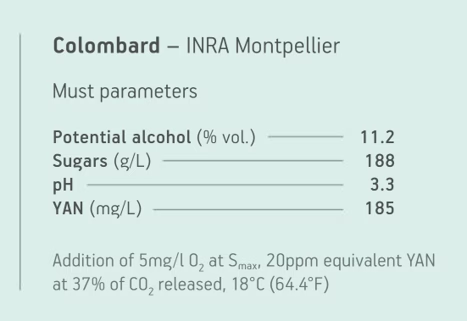
Trial conditions: Colombard must, INRA Montpellier. Must parameters shown above.
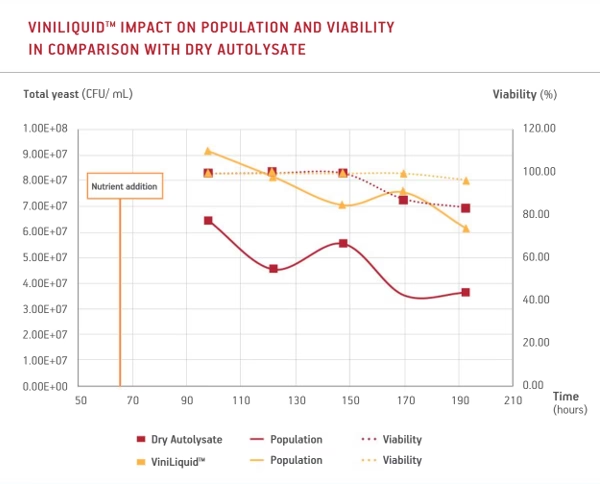
Trial conditions: Colombard must, INRA Montpellier. Must parameters shown above.
The Impact on Wine Quality
Fermentation efficiency is the foundation for quality wine, but what ultimately matters is what ends up in the glass. Here, too, ViniLiquid™ delivers results that go beyond what a standard nitrogen supplement can achieve.
Wines produced with ViniLiquid™ show enhanced aromatic intensity and improved overall balance. A healthier, more complete fermentation reduces the risk of off-aromas associated with yeast stress, and the nutrient profile of ViniLiquid™ supports the conditions under which yeast can express the full aromatic potential of the must.
The result is not just a wine that finishes fermentation cleanly. It is a wine with more to offer aromatically and structurally.
This is particularly relevant in musts where nutrient deficiency is a challenge: high-sugar, low-turbidity, or heavily clarified whites, as well as late-harvest styles where yeast stress is inherently elevated. ViniLiquid™ can be the difference between a wine that expresses its terroir fully and one that carries the hallmarks of a difficult fermentation.
The organoleptic data below, drawn from a Macabeo trial, illustrates the difference clearly.
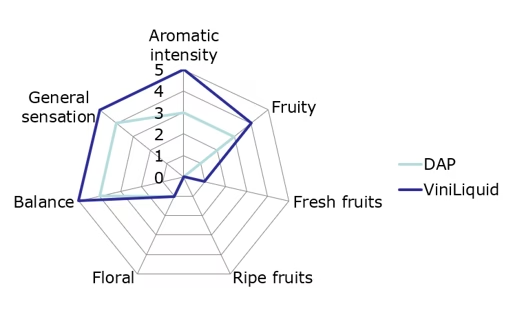
Sensory profile comparison: ViniLiquid™ vs. DAP across aromatic intensity, fruitiness, and overall balance.
Trial carried out in Castilla La Mancha, Spain
- Control: Addition of 10g/hl DAP at 1,080 and 10g/hl DAP at 1,032
- Test: Addition of 20ml/hl ViniLiquid™ at 1,080 and 30ml/hl ViniLiquid™ at 1,036 added manually.
Practical Gains in the Winery
Technical performance is one part of the story. The other is what ViniLiquid™ means for day-to-day operations. After 15 years of use across wineries of all sizes, three operational advantages consistently stand out.
Time: Ready to Use, Directly in the Must
E2U™-certified, ViniLiquid™ requires no prior rehydration. It is added directly to the tank. This eliminates a tedious step that, with dry products, is not optional: dissolving the product. Removing this step and the need to clean containers also saves winemakers time and resources, notably water.
Safety: No Dust, No Inhalation Risk
Some dry yeast derivatives generate fine powder during handling. This is a real occupational health concern in wineries, particularly during harvest when additions are frequent and volumes are high. ViniLiquid™ eliminates this risk entirely. There is no dust, no inhalation hazard, and no need for respiratory protection during routine additions.
Comfort and Automation
ViniLiquid™ is pumpable and homogeneous by nature. This makes it compatible with automated dosing systems, allowing wineries to integrate nutrient additions into automated workflows. For larger operations handling multiple tanks simultaneously, this is a significant operational advantage: consistent dosing, reduced labor, and full traceability of additions.
Dosing, Packaging, and Practical Specifications
ViniLiquid™ is designed to fit the operational realities of professional winemaking, from small family estates to large-volume production facilities.
Recommended Dosage
The standard recommendation is 50 ml/hl, which delivers an equivalent YAN supply of approximately 20 mg/l. Dosage can be adjusted based on must nutrient status, potential alcohol, and fermentation conditions. For maximum fermentative impact, we recommend combining ViniLiquid™ with a controlled oxygen micro-addition at peak fermentation speed.
Shelf Life
ViniLiquid™ has a shelf life of up to 3 years, which is exceptional for a liquid product of this type. This gives wineries the flexibility to purchase in advance without quality risk and simplifies inventory management across vintages.
Packaging Formats
ViniLiquid™ is available in three formats to suit different production scales:
- 12kg HDPE drum (Bidon PEHD): ideal for small to medium wineries, easy to handle and store
- 210kg Easyliquid big bag (Big bag PEBDL): designed for efficient dispensing at mid-to-large scale
- 900kg aseptic IBC (Werit Nutriline): for high-volume operations requiring bulk supply and automated integration
Important Note
ViniLiquid™ is not authorized for organic (BIO) winemaking. Winemakers operating under certified organic production protocols should consult our fermentation specialists for appropriate alternatives within the Fermentis range.
The Verdict After 15 Years
Fifteen years is a long time to validate a product. What ViniLiquid™ has demonstrated is not just that liquid autolysates work, but that the physical form of a fermentation activator is an active variable in fermentation outcomes, not a neutral packaging choice.
The evidence is consistent: faster fermentations, better yeast viability under stress, cleaner pathways to malolactic fermentation, and wines with greater aromatic intensity and balance. On top of that is a winemaking experience that is genuinely simpler: no rehydration, no dust, no homogenization issues, and full compatibility with automated dosing.
ViniLiquid™ was our first E2U™ (Easy To Use) yeast derivative for a reason. It proved that the right approach to formulation can deliver both operational simplicity and a technical advantage simultaneously. That combination is rare, and it is why it remains a cornerstone of our winemaking fermentation range.
If you want to explore how ViniLiquid™ fits your specific cellar conditions, our fermentation specialists are available to help. Contact us through the Fermentis website or find your local distributor to get started.