Français
 简体中文
简体中文 Español
 Italiano
 Português










FOR WELL-BALANCED MEADS
SafMead™ Classic reduces astringency and bitterness, producing well-balanced meads. In some types of honey, SafMead™ Classic is characterized by acetate ester production, ideal for floral and fruity meads.
SafMead™ Classic was selected by Fermentis R&D through multiple microvinifications on various kinds of honey in partnership with a French research institute and mead industry players.
Dosage: 20 g/hl (1.67 lb/1000 gal)
Ingredients: Yeast (Saccharomyces cerevisiae*), Emulsifier: Sorbitan monostearate (E/INS 491)
*According to « Revisiting the taxonomic synonyms and populations of Saccharomyces cerevisiae – Phylogeny, Phenotypes, Ecology and Domestication. » Pontes A., Hutzler M., Brito P.H. and Sampaio J.P., 2020 and « Genome Diversity and Evolution in the Budding Yeasts (Saccharomycotina). Genetics. » Dujon B.A., Louis E.J., 2017; 206(2):717‐750.
SafMead™ Classic sensory features
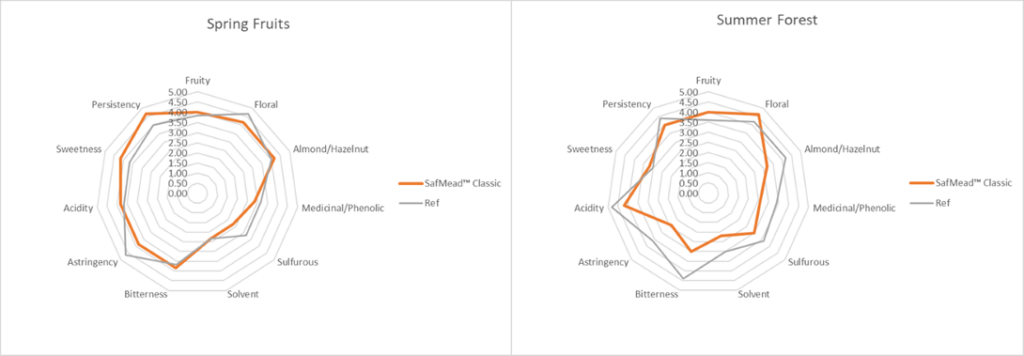
Two different honeys with addition of 50 g/hL DAP, 18°C (64.4°F)
SafMead™ Classic technical features
Fermentation abilities:
- Fast and regular fermentation kinetics
- Recommended maximum alcohol: up to 15% vol./vol.
- Recommended temperature range: 10-30°C (50-86°F)
- Strong nitrogen requirements only to optimize aromatic expression: Ratio YAN (mg/L) / Sugars (g/L): min. 0.8
Metabolic Characteristics:
- POF – (no spicy, barnyard, or medicinal notes)
- Medium production of volatile acidity and SO2, can be limited with a good nutrition program and low fermentation temperature.
Metabolic Characteristics:
- Viable yeast: > 1.0 *1010 cfu/g
- Purity: > 99.999 %
- Lactic acid bacteria: < 1 cfu /103 yeast cell
- Acetic acid bacteria: < 1 cfu /107 yeast cell
- Total Bacteria: < 5 cfu /104 yeast cell
- “Wild” Yeast: < 1 cfu /103 yeast cell
- Pathogenic micro-organisms: in accordance with regulation
1Analysis done according to our HACCP study
Lesaffre know-how and continuous yeast production process improvement generates an exceptional quality of dry yeasts able to resist to a very wide range of uses, including by-passing acclimatization, cold or no rehydration conditions, without affecting their viability, kinetic and/or analytical profile. Winemakers can choose to use our E2UTM yeast with the process that fits best their need:
- Direct inoculation: Inoculate the desired quantity of yeast directly into the must in the fermentation tank, taking care to homogenize the entire volume. In whites or roses, ideally directly sprinkle the yeast into the fermentation tank after the beginning of the transfer from the settling tank and keep transferring to ensure a good homogenization. Alternatively pour the desired yeast quantity on the surface of at least 10 times its weight of must. Gently stir to avoid clumps. Immediately transfer into the tank and homogenize the entire volume.
- With prior rehydration and potential acclimatization: Gently pour the desired quantity of yeast in 10 times its weight of tap water from 15-37°C (59-98.6°F). Gently stir to complete yeast rehydration and avoid the formation of clumps. Leave it to rest for 20 minutes and incorporate the yeast starter in the fermentation tank with homogenization. Following the rehydration, it is possible to continue with an acclimatization by incorporating to the yeast starter ½ of a volume of must and leave it to rest for 10 minutes. Repeat the operation until the temperature difference between the fermentation tank and the yeast starter culture is less than 10°C (50°F).
Packaging
- Box of 160 controlled atmosphere packed sachets of 5g – 0.17oz each (Full box net weight: 800g – 28.22oz)
- Box of 10 vacuum-packed sachets of 100g – 3.53oz each
Shelf-life
48 months from production date. Refer to best before end date printed on the sachet. Opened sachets must be sealed and stored at 4°C/39°F or lower, and used within 7 days of opening. Do not damaged sachets.
Guarantee
The product must be stored/transported in dry conditions and protected from direct sunlight. For less than 6 months, the product can be stored/transported at ambient temperature below 25°C (77°F) without affecting its performances. Peaks up to 40°C (104°F) are allowed for a limited period of time (less than 5 days). Fermentis recommends a long-term storage at a controlled temperature (below 15°C/59°F), once the product arrives to the final destination.
Each Fermentis yeast is developed under a specific production scheme and benefits from the know-how of the Lesaffre group, world leader in yeast manufacturing. This guarantees the highest microbiological purity and maximum fermentation activity.
The information provided by Fermentis is for informational purposes to the attention of professionals only. We make no representation or warranty of any kind, express or implied, regarding the information: regulatory and intellectual property requirements (including product use and claims) shall be reviewed locally for their particular purposes.