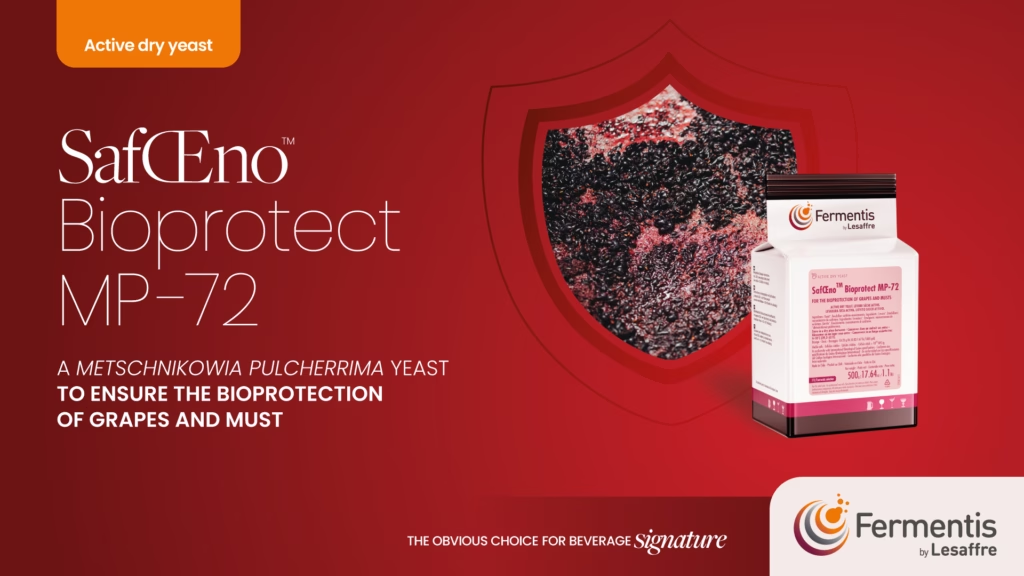
What is this product for?
Selected for its very low fermentation capacity, SafŒno™ Bioprotect MP-72 is particularly suitable for the bioprotection of musts and grapes.
SafŒno™ Bioprotect MP-72 is recommended for pre-fermentation phases:
- On white and rosé musts (cold settling and stabulation).
- On red grapes during cold soak/cold maceration.
What are the key advantages SafŒno™ Bioprotect MP-72 for winemakers?
SafŒno™ BioProtect MP-72 was selected for its ability to colonize the environment and ensure the bioprotection of grapes and musts. SafŒno™ BioProtect MP-72 allows winemakers to reduce or avoid using SO₂ during the pre-fermentative phases.
Pre-fermentative abilities
- Good bioprotection effect with pre-fermentative phases lasting up to 5 days at temperatures below 10°C.
- Tolerance to SO₂ up to 2 g/hL (2.4 oz/1000gal) or 20 ppm of TSO₂.
- High colonization and maintenance of its population in the musts, which limits the development of undesirable wild yeast.
- Low alcohol tolerance (2% vol.) and very low fermentation capacity.
- Does not limit the growth of the yeast selected for the alcoholic fermentation.
- Low consumption of mineral and organic nitrogen, no requirement for additional nitrogen supplementation due to the use of SafŒno™ Bioprotect MP-72.
- No production of undesirable compounds (volatile acidity, SO₂ and H₂S).
How was SafŒno™ Bioprotect MP-72 product developed?
This product was developed in collaboration with the IFV, a public French technical institute. We worked with their collection of microorganisms, including numerous strains isolated from different regions. More than 100 strains of Metschnikowia were studied. Microvinifications allowed us to select the best strains.
Why did Fermentis decide to develop this product?
The use of non-Saccharomyces yeasts is a common practice in œnology. They enable various technical applications, such as bioprotection, reduced SO₂ additions, and organoleptic improvements in wines through increased aroma production. At Fermentis, SafŒno™ Bioprotect MP-72 is one of our first non-Saccharomyces yeasts, and we aim to offer a complete range of these microorganisms, including Metschnikowia, Torulaspora, and Lachancea. This complements the existing range of Saccharomyces cerevisiae yeasts.
For the bioprotection of grapes and musts

 Français
 简体中文
简体中文 Español
 Italiano
 Português