English
 简体中文
简体中文 Español
 Italiano
 Português

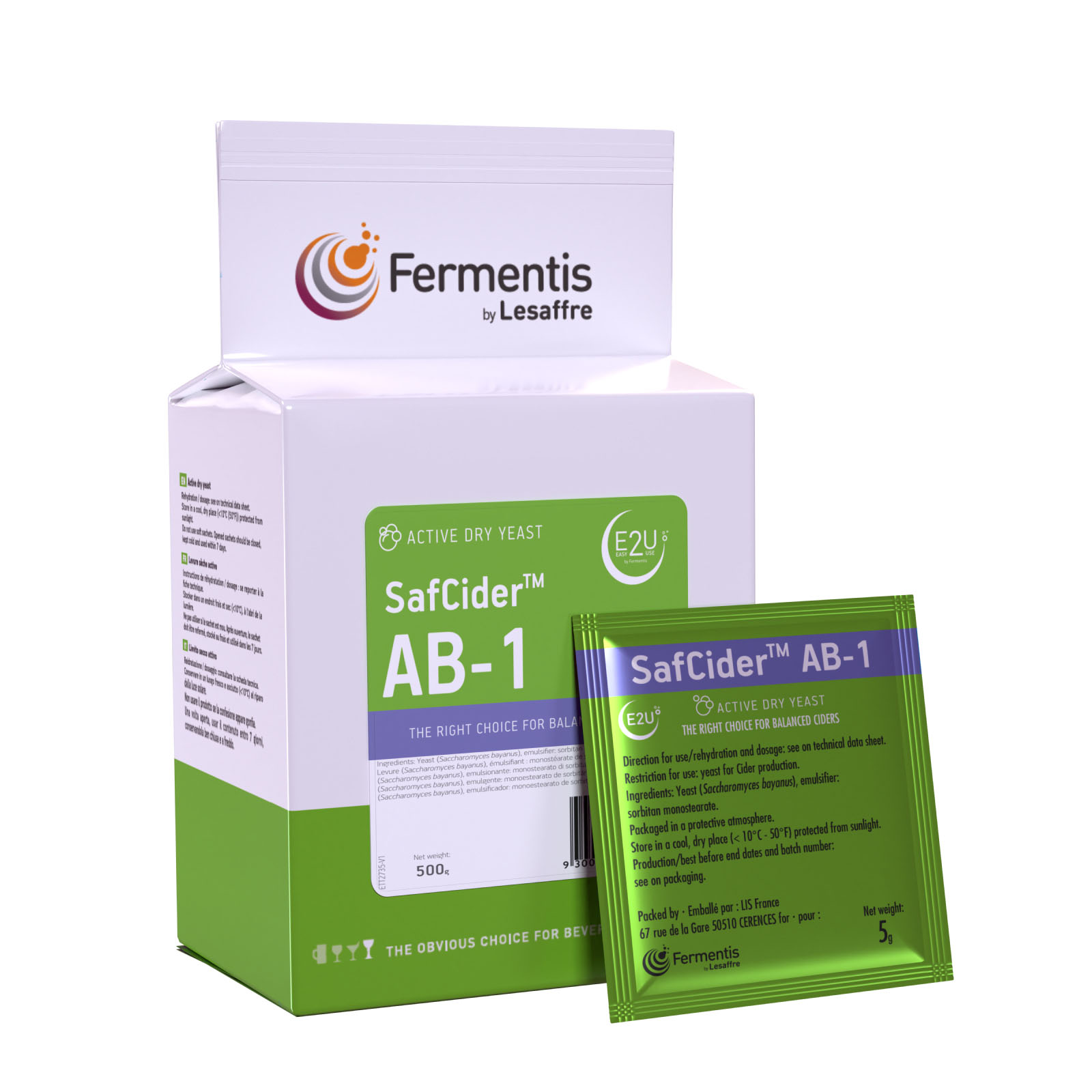
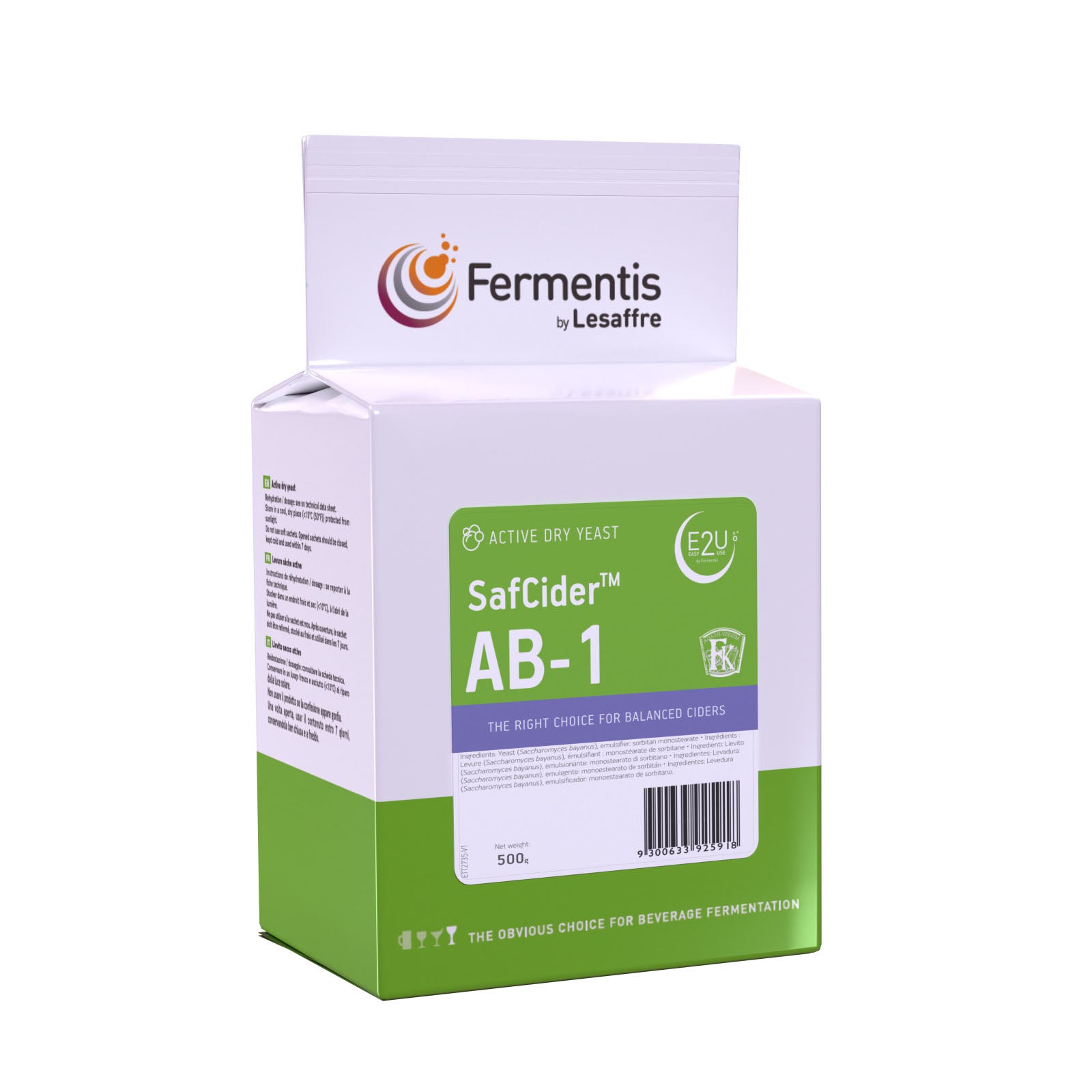
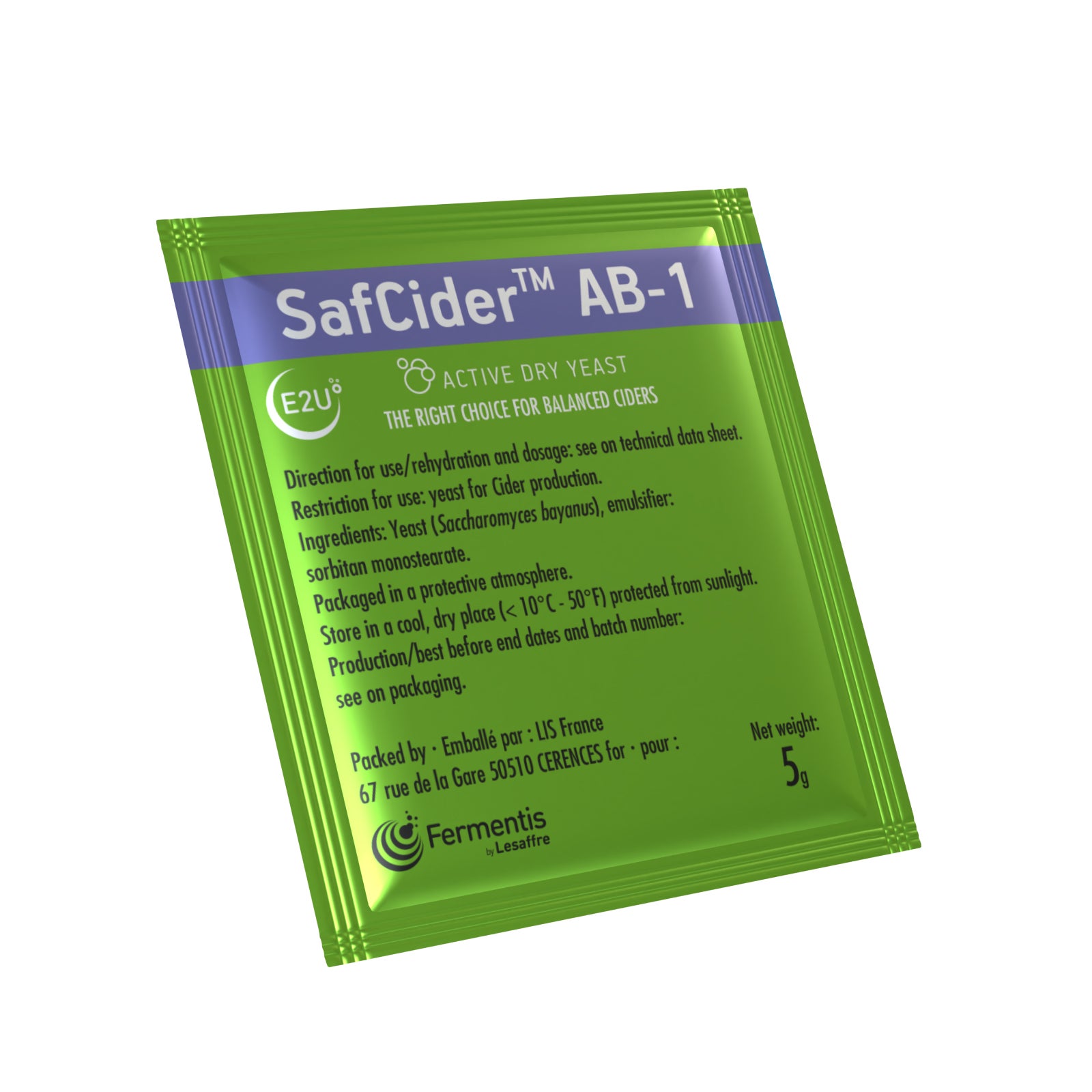








Le choix idéal pour un cidre équilibré
Assure une très bonne assimilation du fructose. Excellente pour les cidres à faible densité.
Ingrédients : levure (Saccharomyces cerevisiae), émulsifiant : monostéarate de sorbitane (E491)
SafCider™ AB-1 - Généralités
Facteur
tueur
aptitude
au cidre sec
Cinétique
Acidité totale
Total
esters
SafCider™ AB-1 - Profil sensoriel
Profil aromatique délicat alliant des notes de fruits frais (pomme) et élaborés (pommes compotées) à une bouche équilibrée respectant la structure du cidre.
Ces observations sont basées sur des essais de recettes de cidre français.
SafCider™ AB-1 - Caractéristiques techniques
Dosage / Température
– 20 à 30 g/hl pour la première fermentation
– 30 à 40 g/hl pour la prise de mousse
Large intervalle de températures de fermentation : 10°-30°C.
Utilisation
Pour cidres doux et secs à base de jus de pommes frais ou concentrés.
Convient aux conditions de fermentation difficiles et aux mélanges avec sirops de sucre.
Procédure de réhydratation :
① Ensemencement direct :

Saupoudrer la levure à la surface d'au moins 10 fois son poids de moût (éventuellement directement du haut de la cuve ou lors du remplissage de la cuve après clarification).
Remuer délicatement pour éviter la formation de grumeaux ou les rompre.
Transférer immédiatement dans la cuve par remontage avec aération (ou homogénéiser la masse de la cuve).
2. Avec réhydratation préalable :
Saupoudrer la levure à la surface de 10 fois son poids d'eau du robinet à température ambiante.
Remuer délicatement pour éviter la formation de grumeaux ou les rompre.
Attendre 20 minutes et transférer en cuve par un remontage avec aération.
- Très bonne force d'implantation malgré sa sensibilité au phénotype killer
- Cinétique régulière
- Large intervalle de températures de fermentation : 10°-30°C
- Besoins en azote très faibles : rapport azote assimilable par la levure**(mg/L)/sucre(g/L) >0,7
- Très bonne assimilation du fructose
- Niveau initial maximal de SO2 recommandé : 125 mg/L
- Consommation importante d'acide malique (jusqu'à 1,5 g/L)
- production moyenne de 2-phényléthanol et d'acétate d'isoamyle . Les notes amyliques peuvent être amplifiées notamment lorsque le rapport azote assimilable/sucre >1
- Levure viable > 1,0×10¹⁰ ufc/g
- Pureté : > 99 %
-
-
- Bactéries lactiques : < 1 ufc/107 cellules de levure
- Bactéries acétiques : < 1 ufc/107 cellules de levure
- Pediococcus : < 1 ufc /107 cellules de levure
- Bactéries totales : < 5 ufc/107 cellules de levure
- Levure « sauvage »* : < 1 ufc /107 cellules de levure
- Micro-organismes pathogènes : conformément à la réglementation
-
*EBC Analytica 4.2.6 – ASBC Microbiological Control-5D
Conditionnement
Boîte de 160 sachets emballés sous atmosphère contrôlée de 5 g chacun (poids net de la boîte complète : 800 g)
Carton de 20 sachets sous vide de 500 g – 17,63 oz chacun (Poids net de la box complète : 10 kg – 352,74 oz)
Carton contenant 1 box sous vide de 10 kg (Poids net de la box complète : 10 kg – 352,74 oz)
Conservation
Pour une durée de stockage de 6 mois ou moins : le produit doit être stocké à une température inférieure à 25 °C (77 °F). Pour une conservation de plus de 6 mois : le produit doit être conservé à une température inférieure à 15 °C (59 °F). Pendant une courte période n'excédant pas 7 jours, conservez-les simplement dans un endroit frais et sec.
Durée de conservation
48 mois à compter de la date de production. Se référer à la date limite de consommation optimale imprimée sur le sachet. Les sachets ouverts doivent être hermétiquement refermés, conservés à maximum 4°C et utilisés dans les 7 jours suivant l'ouverture. N'utilisez pas de sachets endommagés.
Vous pourriez trouver une classification de levure différente pour ce produit sur nos sachets et sur les anciennes versions de nos outils de communication.
En effet, ce produit était auparavant classé comme Saccharomyces bayanus, mais comme la classification taxonomique des levures est en constante évolution, la dernière édition de «The Yeast, a taxonomic study » nous a fait réviser notre classification pour être en phase avec la communauté scientifique.
Dans un souci de durabilité, nous avons fait le choix d’utiliser notre stock de sachets avant d’en réimprimer de nouveaux.
En attendant, ne vous inquiétez pas si vous avez déjà fermenté votre boisson avec cette souche de levure, la classification taxonomique des levures n'a aucun impact sur les caractéristiques du produit.
Contenu similaire
Sorry, no pages was found