


Faster fermentations, better aromas: The SafŒno™ EF 85 advantage for Chardonnay
Fermentative microorganisms are affected by the physio-chemical characteristics of their environment. In a winemaking context, temperature and yeast nitrogen nutrition play a major role in the wine quality and sensory profile. They affect aroma production during fermentation, while temperature also bears influence on fermentation time which can in turn impact the aroma profile. While many studies focus on the temperature and nitrogen impacts, we’ve gone a step further to analyse not only two, but three factors in the case of a Burgundy Chardonnay wine: the fermentation temperature, the yeast assimilable nitrogen (YAN) in the starting must and the type and moment of nitrogen nutrient addition (mineral and/or organic). Our study investigates how these three different parameters that can impact yeast performance, more specifically the performance of SafŒno™ EF 85.
We observed the potential impact of these three factors on fermentation kinetics, aroma production during fermentation and sensory profile. We are very excited to be able to reveal the key findings from this research project.
Key findings – fermentation kinetics
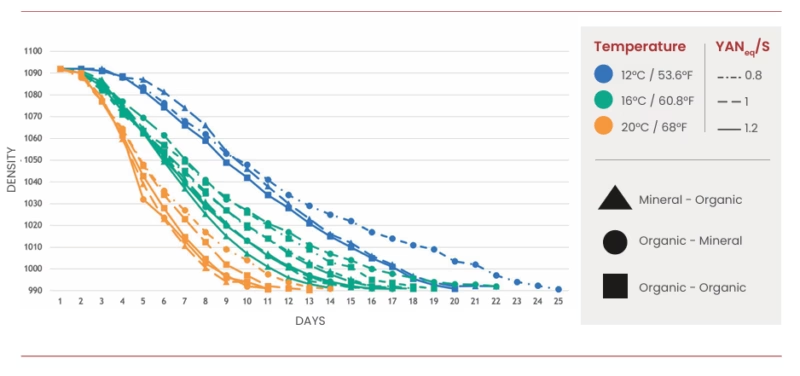
Regardless of the conditions, all fermentations were completed between 10 and 20 days.
As expected, the higher the temperature, the faster the fermentation.
The higher YANeq/S, the faster the fermentation, at each of the three temperature conditions.
It is therefore possible to compensate for lower fermentation temperatures with increased YAN.
Key findings – volatiles
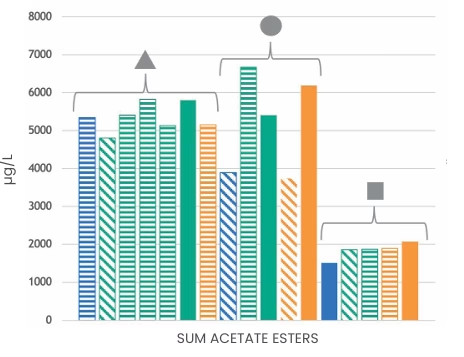
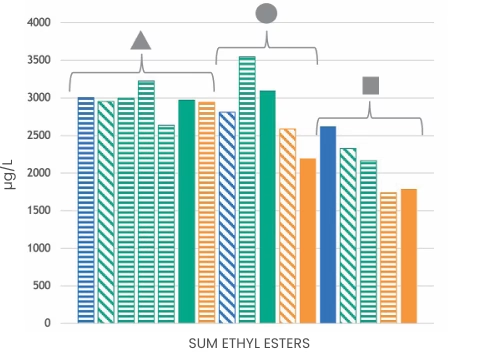
Regarding volatiles production, it is interesting to note there are subtle differences according to the conditions, meaning it is possible to actively steer your aromatic profile depending on the choices you make.
For higher acetate esters, it is best to ferment at slightly higher temperatures (16° to 20°).
Ethyl esters, however, seem less affected by temperature, but appear to be promoted a little more by lesser temperatures (12° to 16°).
It seems the best nutrition protocol to promote volatile compounds is a mix of mineral and organic YAN – the order in which they are used does not show any clear benefits.
Key findings – sensory analysis
The tastings of the 14 samples were conducted using the Pivot© method.
From the tastings, we can conclude that medium to low temperatures promote fruitiness, length and volume in mouth. Temperature is the key contributor to guiding the aromatic profile of the wine.
At lower temperatures, either using a higher YANeq /S ratio, or a full organic nutrition protocol, will also enhance the intensity and fruitiness sensation.
Conclusions of our study
It was interesting to see that playing with several parameters, including nutrition, can have a strong impact on guiding the aromatic profile of the wine. Although temperature is perhaps the most important factor from this study, there are definitely ways of steering the profile through the smart use of nutrition. The optimum for SafŒno™ EF 85 on Chardonnay, which has rather low YAN requirements, can be achieved through a combination of organic and mineral nitrogen nutrition, at medium to low temperatures (12° to 16°).
In future explorations of these kinds, we would like to go into more depth on the volatiles, perhaps with less parameters, to really pinpoint the observed optimum.
Statistical modelisation and artificial intelligence could also help to increase our understanding of fermentation management and achieve better results with similar investment.
Our goal, as always, is to provide the right information and give you the tools to steer your fermentation, and ultimately, produce the best wines, in line with your market expectations. Feel free to reach out to your local expert for more information on this study, on SafŒno™ EF 85 or on Fermentis in general: we’re here to help!
Coline Leriche
Fermentis Academy Sensory Analysis Manager