
How Yeast Nutrition Impacts Your Final Wine ?
Available nutritional elements in musts help yeasts and bacteria to improve and accelerate fermentations. Nutritional compounds can be divided into macronutrients (needed for cell material renewal) and micronutrients (oligo-elements and enzymatic co-factors needed for biochemical reactions within the cell). Carbon sources (glucose, fructose, …), phosphate, sulphur, lipidic compounds (long chain fatty acids, sterols, …) are considered as macronutrients. Vitamins and minerals are regarded as micronutrients. These different compounds can have beneficial effects on the yeast performance through improved fermentations kinetics and aroma production.
Focus on Nitrogen
Yeast can assimilate different nitrogen sources considered as Yeast Assimilable Nitrogen (YAN). The YAN is composed of primary or alpha amino acids (excepted proline), or organic nitrogen, and ammonium nitrogen, also called mineral nitrogen.
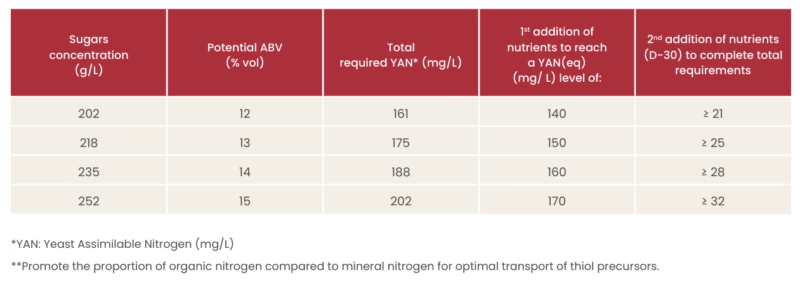
The minimum YAN level for a complete fermentation run has been estimated to be 140 – 150 mg N/L. However, this number has been established for musts containing sugars concentrations equivalent to potential ABV of 12 – 12,5 % vol. As sugars concentrations increase, the need of YAN increases consequently. An interesting approach to estimate the YAN requirements of the yeast is by considering the ratio YAN (mg/L)/ Sugars (g/L). An average ratio for wine yeast is 0.8. An additional consideration for a good nutrition management, are stress factors (turbidity deficiency, high ethanol levels, …). Any form of stress leads to increased nutrition requirements by the yeast, specially, in terms of survival factors such as ergosterol and long chain fatty acids.
Focus on Lipids
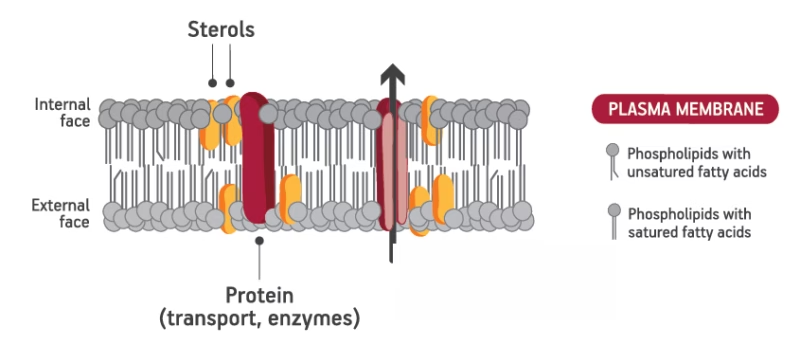
Sterols are especially present at the membrane protein sites (enzymes, transporters) to maintain the transport activities of the yeast.
When the ethanol concentration increases during fermentation, it replaces water molecules linked to membrane phospholipids, which alters the fluidity of the membrane and its capacity to transport sugar and amino acid. Moreover, without oxygen, cells are synthetizing saturated fatty acids, having an inhibitory effect on transport activity while accumulating at the level of the yeast cell wall. This synthesis can also be stopped, leading to the presence of particularly toxic, medium-chain, saturated fatty acids, that will disturb the membrane fluidity.
That is why oxygen addition is crucial to maintain yeast viability, leading the fermentation to the end. Sterols and fatty acids are considered as “oxygen substitutes.” These compounds, that we can find in yeast cell walls, are named “survival factors”. In case of lack of oxygen, yeast derivatives, more specifically, yeast hulls (or yeast cell walls) can act both as detoxifiers by adsorbing medium-chain saturated fatty acids and as supplement of survival factors. Their capacity to release unsaturated fatty acids and sterols improves active yeast membrane resistance towards ethanol toxicity.
Yeast Derivatives are not only a source of Yan
Among the fundamental needs of yeasts for its growth and survival, It is interesting to note that most of the fundamental needs for the growth and survival of yeasts can be supplied naturally through yeast derivatives. Yeast derivatives contain unsaturated lipids and sterols, vitamins, minerals and available organic nitrogen. Yeast cell walls, inactivated yeasts and yeasts auto lysates have different nutritional composition.
Specific yeast cell walls contain the highest amounts of survival factors while yeast autolysates contain the highest amounts of assimilable organic nitrogen, vitamins and minerals. In winemaking, these different categories of yeast derivatives are to be considered as sources of a complete set of nutritional compounds rather than just a source of assimilable nitrogen. In this case, we often speak about the nutritional value in terms of YAN equivalent. Equivalent YAN translates the global nutritional value of a yeast derivative based fermentation aid compared to that of pure ammonium nitrogen needed to achieve similar performance in terms of fermentation kinetics.
Focus on the moment of addition
The first goal of any nutrition addition is to correct deficiencies to build an adequate healthy and strong biomass capable of completing the alcoholic fermentation. A second goal can be to enhance the aromatic intensity and complexity. Considering the first goal, there are crucial moments for adding nutrients. Several cases can occur:
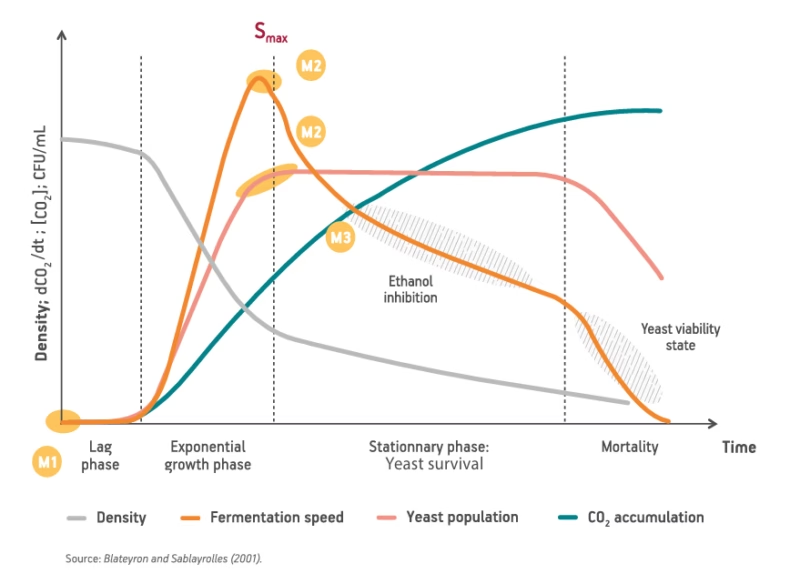
MOMENT 1 (M1): YEAST INOCULATION
No initial deficiency : no nutrient addition required.
YAN deficiency : a must is generally composed of 1/3 mineral nitrogen and 2/3 organic nitrogen. In case of optimised varietal thiols expression, nitrogen additions should be made to keep as close as possible to the natural balance of nitrogen in the musts (SpringFerm™ Xtrem, Viniliquid™ in combination with DAP if needed). In other cases, YAN deficiency can be made with mineral nitrogen and thiamine.
Turbidity deficiency : too strong clarification can lead to lack of insoluble yeast support elements, lipids, vitamins and minerals. In this case, adding inactivated yeasts/partially autolysed yeasts (SpringFerm™) full of nutrients and insoluble parietal parts is a good option to compensate deficiencies.
MOMENT 2 (M2): MAXIMUM SPEED OF FERMENTATION
An oxygen supply (10 mg/L with micro-oxygenation or pumping over with aeration), or alternatively, high ergosterol containing yeast cell walls (SpringCell™), will help build a strong viable yeast population.
MOMENT 3 (M3): THIRD OF ALCOHOLIC FERMENTATION
At this moment, there is neither dissolved oxygen nor available nitrogen sources in the must. Yeasts need directly available nutrients and the cleanest environment in regard to toxic elements (medium chain fatty acids, …). Using inactivated yeasts/partially autolysed yeasts (SpringFerm™), yeasts autolysates (SpringFerm™ Xtrem, Viniliquid™) and yeast cell walls (SpringCell™) help to address these needs.
Focus on quantity and timing
Demonstrated in the table below, there is a direct correlation between the nutritional requirements of the yeast and increasing sugar concentrations. Considering an average YAN (or YAN equivalent) need of 0.8, the total requirement for a fermentation run can be estimated as following: